Architecture is usually presented at its best: a clean plan, a composed façade, a room with nothing out of place. Louis Hellman asks what happens when real life walks into the drawing. In one of his sharpest images, an orderly architectural interior becomes a crowded, colourful domestic scene. The joke lands because the gap between the two is familiar to anyone who has lived in a house.
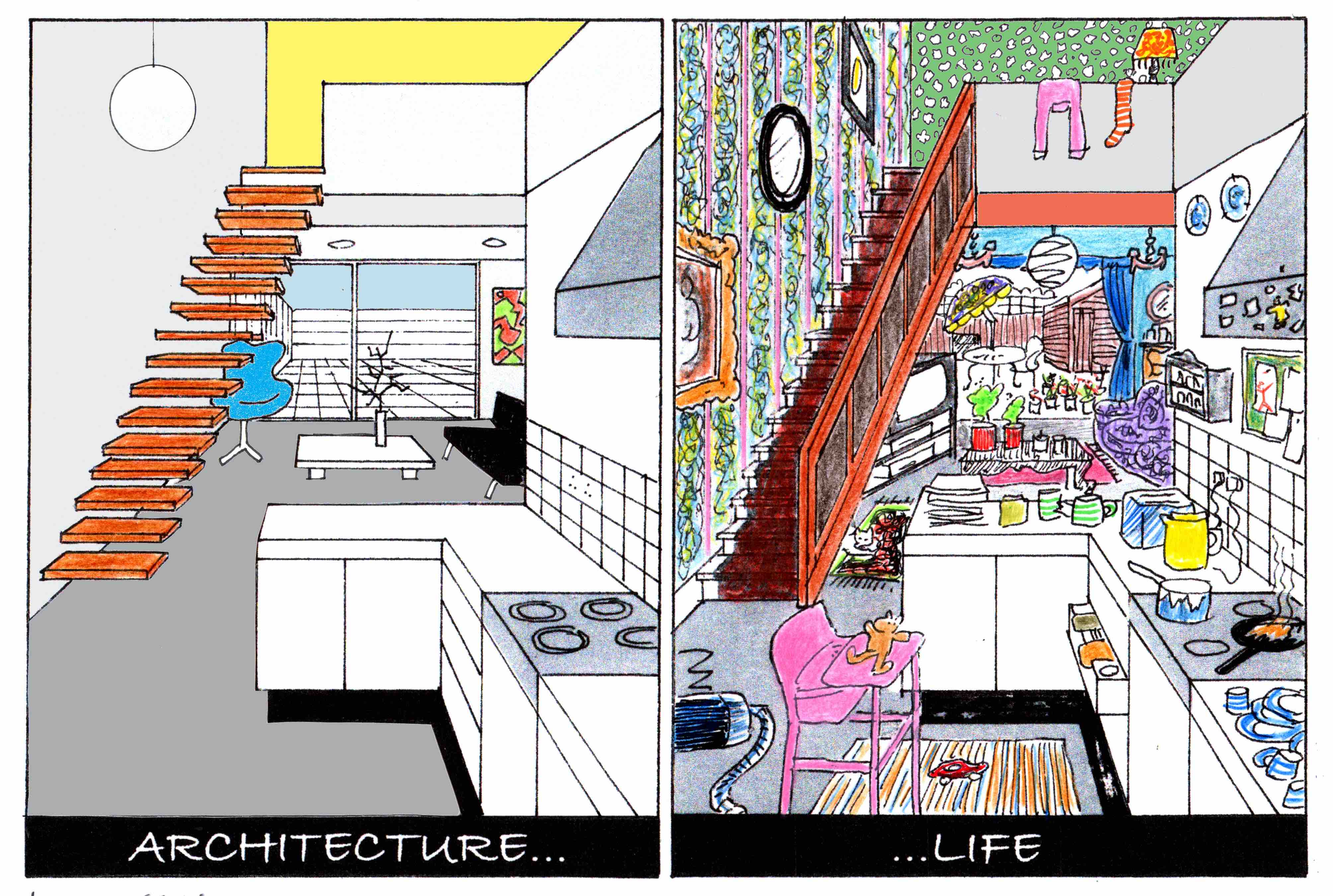
Hellman is an architect as well as a cartoonist, and that combination gives his satire its bite. He knows the language, rituals and ambitions of the profession from the inside. His drawings can be affectionate, but they do not flatter architects when professional certainty drifts away from the people who have to use the buildings.
A cartoonist with an architect’s eye
Hellman studied at the Bartlett School of Architecture and worked in a modernist practice after qualifying. In his own account, the experience changed how he saw the movement. Ideas that had once promised social purpose and new ways of living could harden into a set of rules, defended even when they did not fit ordinary life. Cartooning gave him a way to test those claims against what people actually experienced.
His first cartoon for Architects’ Journal appeared on 11 October 1967. It took aim at a proposed extension to the Palace of Westminster. From there, his subjects widened: architectural fashions, planning and politics, the language used to justify design, and the distance between professional ideals and built reality.
The cartoon was the start of a long-running conversation with the profession. In 1967 Hellman joined the Greater London Council and Inner London Education Authority’s schools division, where he encountered public architecture shaped by tight budgets and institutional decisions. He later described a clash over the imposition of prefabricated schools that he considered unsuitable. In 1974 he moved to the Spastics Society’s architects department, now Scope, where the everyday barriers facing disabled people made access a central design question. These experiences widened his satire beyond style: they gave it a practical test, asking who a building actually serves.
Hellman’s recurring architect figure helped carry that conversation from cartoon to cartoon. He described the character as a small, round, bearded, bow-tied professional: often a spectator who reacts to events rather than controlling them. The figure is comic partly because he looks so self-assured, yet the world around him keeps exposing the limits of his control. It gave readers a recognisable guide through changing architectural debates without making each cartoon depend on a long explanation.
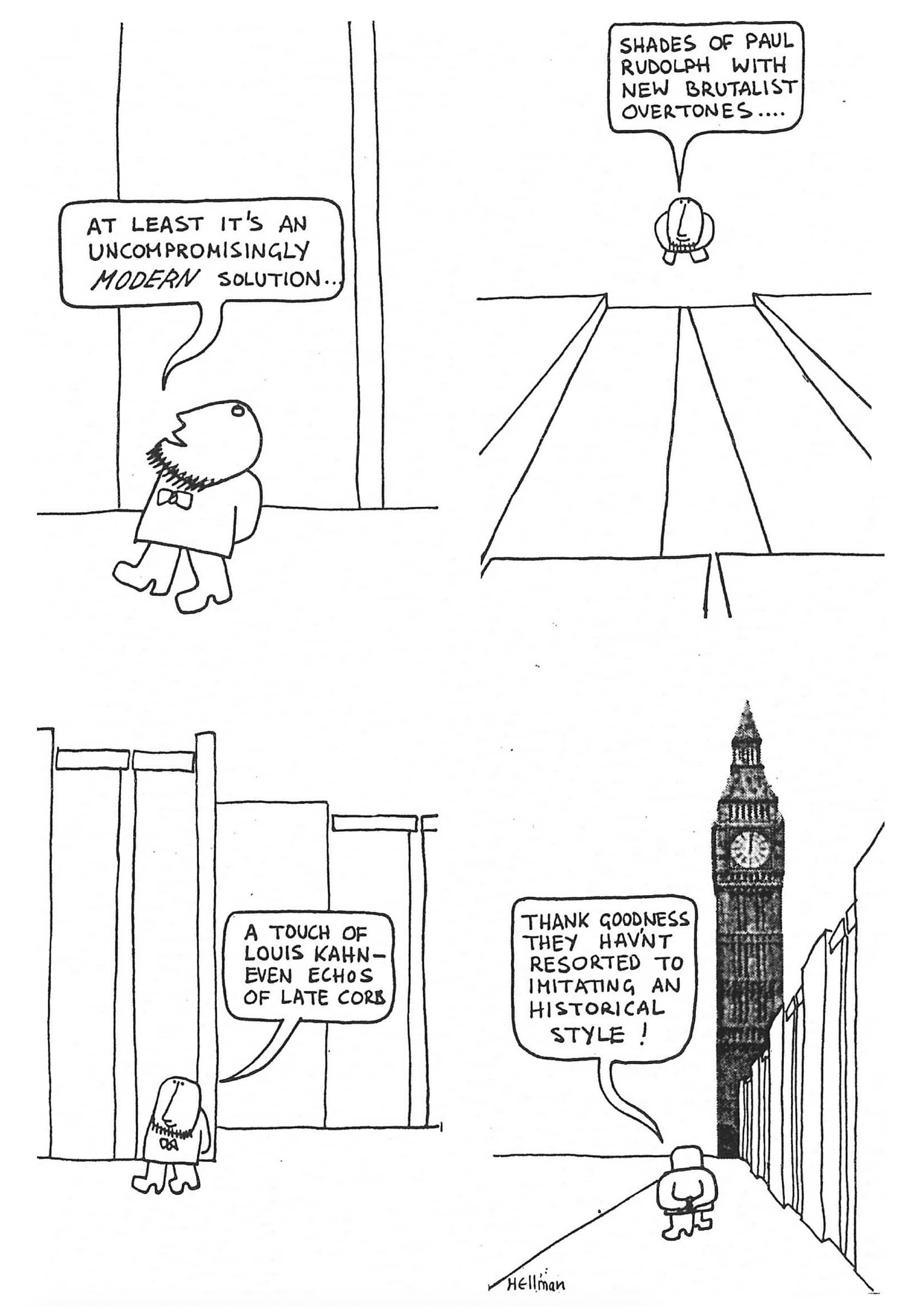
When buildings become portraits
Hellman’s best-known series, Archi-têtes, turns architects into caricatures built from the visual language of their own work. The name plays on the French word for heads: these are portraits in which architecture becomes part of the person. In his image of Sir Christopher Wren, for example, the architect’s wig becomes the dome of St Paul’s Cathedral.
The conceit is funny, but it is also a compact piece of criticism. An architect’s style is so recognisable that it can seem to take over the person behind it. Hellman makes the signature visible, then nudges us to ask what it reveals and what it hides. The drawings are not just jokes about famous architects; they are a visual shorthand for the way ideas, reputations and buildings become inseparable.
Seven stages in an architect’s life
Hellman returned to professional identity in Seven Ages of the Architect, an anthology first published in 1991. Its imagined career begins with a child playing with building blocks and proceeds through the schoolchild, student, young idealist, partner and RIBA councillor before reaching the aged Neo-Classicist. The sequence is affectionate but pointed: as the architect gains credentials and status, convictions and tastes can shift with them. The last stage turns a whole career into a punchline about the profession’s capacity to circle back to the styles it once rejected.
The cartoon works because it is more than a list of life stages. Each version of the architect carries a different relationship to architecture: play, discovery, idealism, practice, institution and finally nostalgia. Hellman compresses those changes into a single visual joke, making the profession’s self-image as visible as its buildings. The RIBA Collections feature on the illustration uses it as a starting point for thinking about the varied objects and experiences that accumulate over an architectural career.

The people left outside the drawing
Some of Hellman’s strongest work looks beyond architectural style. In his reflections on practice, he questioned the idea of an “average” user and the habit of designing around an imagined, able-bodied person. He later worked in an architectural department serving disabled people, where everyday barriers such as steps, narrow doors and inaccessible facilities were impossible to treat as minor details.
That concern connects the humour to a serious point: buildings are judged in use. A beautiful drawing cannot make a difficult entrance accessible, and polished language cannot make a space comfortable for the people it overlooks. Hellman’s cartoons return architecture to that test. They make the user visible again.
A changing profession, seen in sequence
Read across decades, Hellman’s cartoons form a running visual commentary on architecture’s changing claims. He turned his attention to the retreat of high-rise, the bruising of New Brutalism, the rise of Postmodernism, the politics of the 1980s, speculative development, community architecture, computer-aided design, Deconstruction, High-Tech, Blobitecture and sustainability. The styles are different, but the recurring question is familiar: what happens when the image architects make of their work meets the realities of power, money, planning and use?
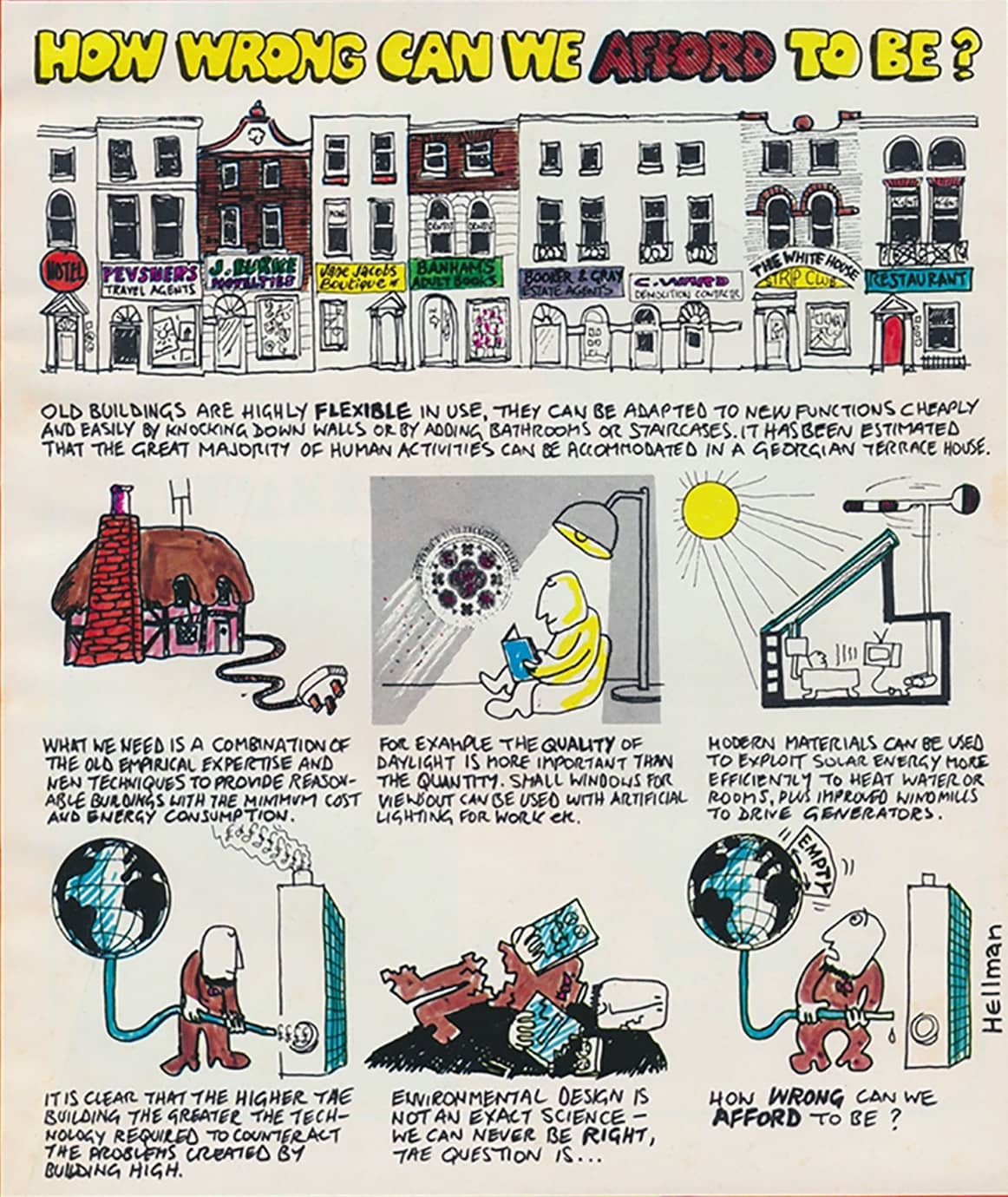
His response to environmental concerns was just as direct. In a 1976 cartoon for the RIBA Journal, Hellman asked how wrong society could afford to be about energy conservation, pairing the question with competing ideas about how buildings are used and powered.
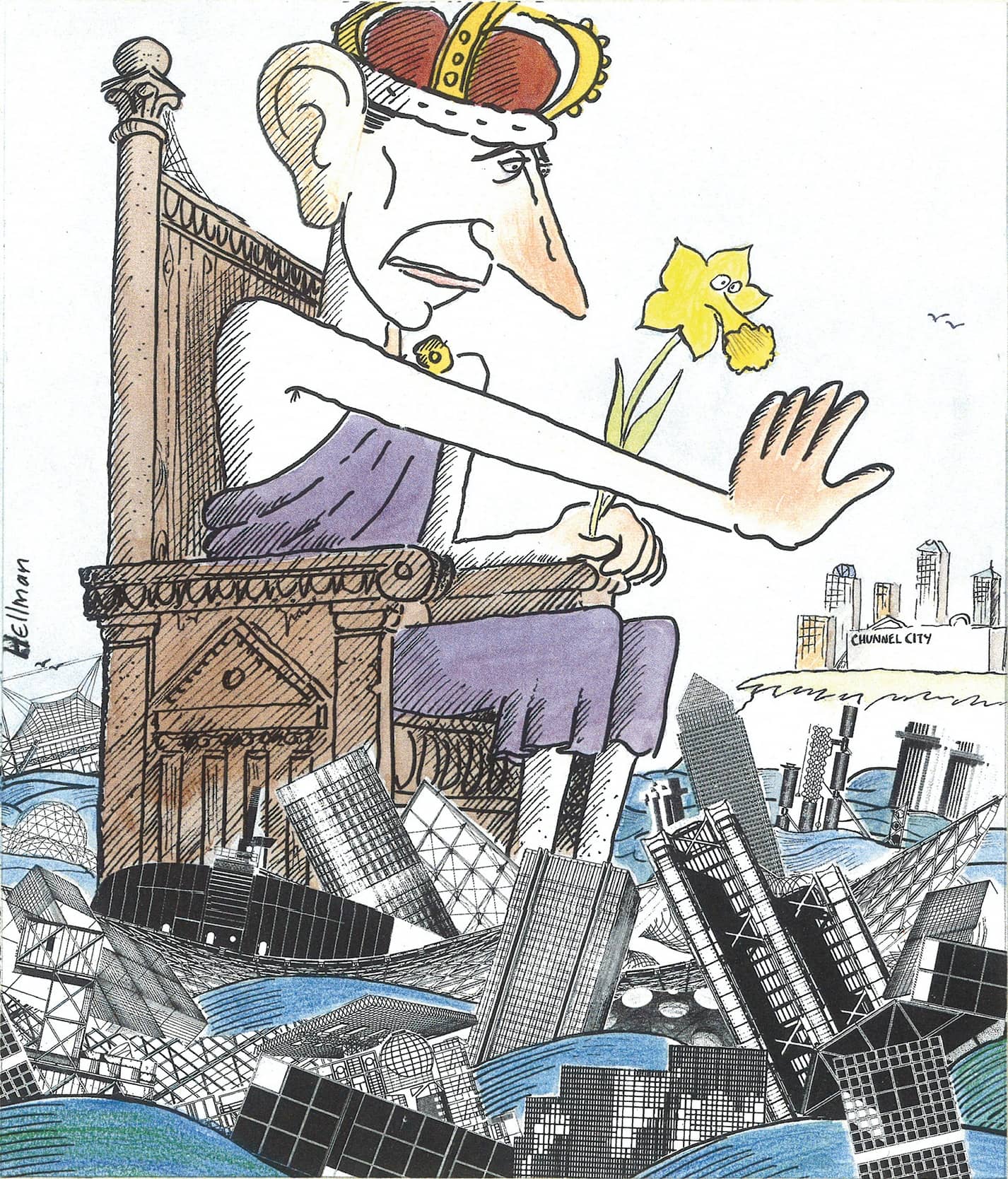
Political power also became a recurring subject. Hellman drew on Prince Charles’s public attacks on modern architecture, placing the prince’s traditionalist stance against the very cityscape he sought to criticise.
That continuity became especially visible in October 2026, when Architects’ Journal announced that Hellman was stepping back from its regular cartoon slot after nearly 60 years. The milestone matters because it marks not simply a long career, but an unusually sustained record of the profession talking to itself—and being challenged by one of its own practitioners.
Why the jokes still matter
Architecture changes its vocabulary, but the distance between the promise and the result remains a rich subject. Every era has a new style to defend, a new set of terms that can make a questionable decision sound inevitable, and a familiar temptation to treat the building as the whole story.
Hellman’s work is a reminder that architecture is never only an image. It is politics, money, access, maintenance and daily routine. His humour makes that argument without turning it into a lecture. The drawing catches the contradiction; the reader supplies the recognition.
That may be why the cartoons have lasted. They are made by someone who understands the discipline well enough to tease it precisely, and who knows that the most revealing view of a building often begins after the architect has left the room.
Further reading
- Louis Hellman’s official website
- “50 Years a Cartoonist,” Buildings & Cities
- “A Life in Architecture,” RIBA Collections
- Louis Hellman’s Archi-têtes portrait of Sir Christopher Wren, RIBA Collections
- “Remembering 60 years of AJ cartoonist Hellman,” Architects’ Journal (via Construo)
Books on Louis Hellman
Four books that bring together Hellman’s cartoons and his playful, critical view of architecture.
 Seven Ages of the Architect
Charles Knevitt
Hellman’s collected cartoons follow the architect from childhood through professional life and old age.
 Archi-Têtes: The Id in the Grid
Louis Hellman
Architectural portraits turn famous designers and their buildings into witty caricatures.
 Architecture A to Z: A Rough Guide
Louis Hellman
An illustrated, satirical guide to architectural terms, people and ideas.
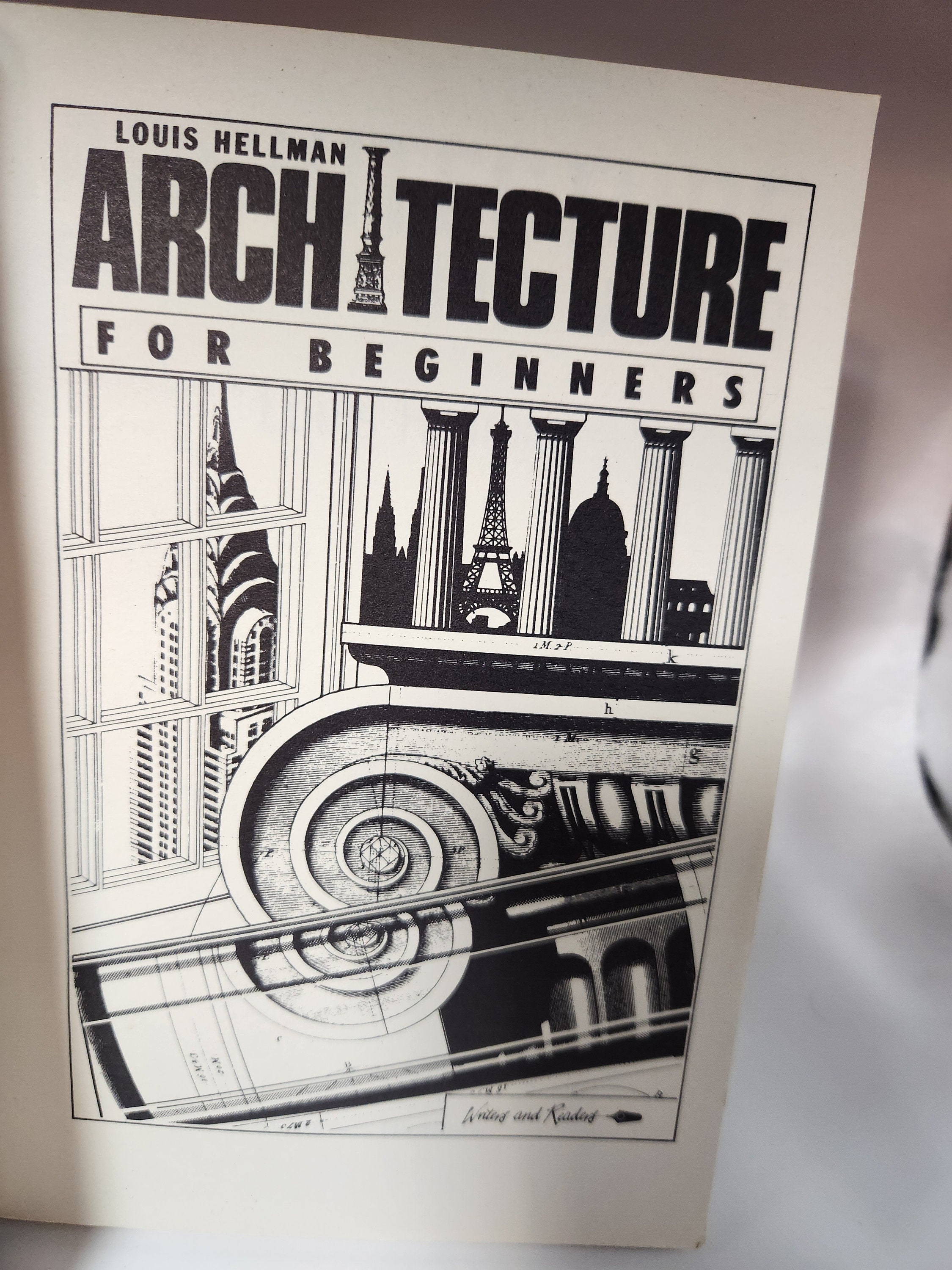 Architecture for Beginners
Louis Hellman
A lively introduction to architecture, told through Hellman’s own drawings.
All cartoon images remain the work and copyright of Louis Hellman and their credited collections. Images are included here for commentary and linked to their source.


No comments:
Post a Comment
Thanks for taking the time and effort to comment :)